

When I finished the Product management from the trenches series, I had told the story of how we built a product function from scratch at Nalanda, a company where the discipline barely existed. Some decisions worked, others less so, and a few cost me blood, sweat and tears.
I am now Manager of Customer Experience Engineering (CXE) at DoiT. I lead a fully remote team made up of four product engineers and me, and we build Synapse. Synapse is the main product in our agentic service platform. Our mission is to move DoiT’s service from a linear cost model to AI-led, human-backed operations.
The problem feels very similar to the one I faced back then: shaping how a product team works. What has changed is who counts as part of the team.
An operating model that agents read too#
Marty Cagan uses product operating model to describe the set of decisions, roles, rituals and rules that define how a team discovers, builds and delivers value. Every team has one, even if nobody has ever written it down. It usually lives in a wiki, in the manager’s head and in the habits the team picks up over time.
That works reasonably well while the people following it are human. People fill in the gaps, ask when something does not add up and remember last week’s conversation. An agent does none of that: it applies what is in its context and executes based on prompts. That is why we have to be intentional about what we put into that context (this is where context engineering comes in) and descriptive about what we want. But a prompt is still a promise. It may or may not be kept. So we need mechanisms that ensure that, if you want the agent to work in a particular way, it is able to validate itself.
That is why we decided that the part of the operating model that can be written down should live in its own repository, cxe-os. The different agents (human or otherwise) and systems — our team agent, our control centre and the coding agents we program with — all read their rules from there. The repository lets us record every change and evolve the model over time, instead of piling up prompts or skills and hoping that everyone remembers to use them, or that the agent decides to.
Mind you, not everything in an operating model fits into a repository. The outcome we are pursuing, the risk we are willing to take or what we decide to kill are still decisions made by people. cxe-os is the codified part of the model; the model itself is much bigger.
The bill nobody wants to pay#
At Nalanda, I learnt that knowing the principles of product management does not guarantee that an organisation can put them into practice. Almost everyone agrees with working towards outcomes, running continuous discovery, empowering teams and measuring impact. The problem starts when the bill arrives: keeping information up to date, documenting decisions and returning to shipped work when the next urgent thing is already pulling us elsewhere.
In a team of five, that bill weighs even more, because the opportunity cost is huge. I did not want a large chunk of our time to disappear into “administrative” work. Don’t get me wrong: I obviously think writing has a lot of value, not least because it helps you organise your ideas. But if you can lean on frameworks, templates and processes that reduce the cognitive load and let you focus where you add value, that is a pretty reasonable productivity boost.
An operating model is half engineering, half gardening#
I like to think that doing product today has a lot in common with solving complex problems, and in that sense a product person carries a cognitive meta-toolkit that they apply to their responsibilities as they interact with the problem at hand.
When I was hiring the team, I was already looking for people with a product mindset, and I knew where I wanted to go in terms of business objectives and ways of working. What I did not want was to turn up on day one and tell everyone exactly how to work, down to the last detail, because I did not know myself what I would find once we tackled the problem.
So, back to the title of this section: product management is a discipline by people for people, and that leads me to think that a product operating model is half engineering and half gardening. The engineering is what you can design and write down: states, templates, rules. The gardening is about planting a few practices, seeing which ones take root with this particular team, pruning what does not work and letting the rest grow. cxe-os is the engineering. The gardening is still our job.
This is where agents change the maths. They can take on much of the work that used to create the friction that makes teams stop following good product practices — whichever ones the team chose — the ones you let slide when the week gets complicated. In CXE, I would sum it up with an expression I really like: AI-led, human-backed. Agents execute and people decide.
How the pieces fit together#
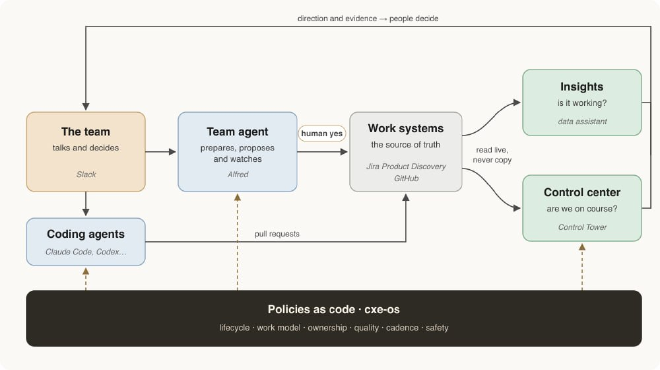
The conversation starts in Slack. Alfred, our team agent, sits in the main channels (more on this in the upcoming posts) and captures the context of the conversation to turn it into work in Jira Product Discovery (JPD). It does not capture the task, but the intent in business terms, and it never writes anything without a person confirming it. The engineers create the specs from that intent, build with their coding agents and open PRs in GitHub (GH), where agentic PR reviews and the CI/CD pipeline for deployments kick in. Control Tower can then interact with JPD, GH and Alfred so we can understand where to put our focus, from the most strategic to the most tactical. Finally, we would not be a complete product team if we were not connected to the data insights layer, which gives us back two things: where we are heading and whether it is working. Underneath it all, cxe-os makes sure everyone follows the same rules.
I do not yet have a quantitative result showing how much the model improves things. That’s why this series will cover the decisions and also what doesn’t work yet.
What I will cover in this series#
As we reviewed how we wanted to work in CXE, I asked myself how a product team should work in the era of generative AI, and how this whole technology stack and tooling could help us day to day. This series of posts tries to bring order to the decisions we have made along the way, so that other product teams can learn from them as we have, and reach the level of performance I believe we are at now.
DISCLAIMER: I am not trying to lay down the law, far from it. I believe product and technology teams are a consequence of their own traumas and scars, so we are probably here — whether in spite of or thanks to our mistakes, I am not sure.
As we reviewed how we wanted to work, we settled on eight decisions, which are what I will cover in this series of posts.
The series follows the lifecycle of a need, from the moment someone mentions it in Slack until we learn whether what we built was worth anything. Then it goes down to the foundations that hold it all up.
From conversation to learning#
- Everything starts with an outcome. Why every item is born with an objective and the key result it aims to move, and why reviewing impact after 30 days is still more intention than habit.
- From a signal to a spec. How a conversation with an FDE ends up as a validated item and then a spec, with a Definition of Ready acting as the gate.
- Building and shipping with agents. Spec-driven development, coding agents, agentic PR reviews and the path from merge to production: what we delegate and what a person still reviews.
- Learning faster. The feedback loop with users; usage, delivery, AI cost and business data one question away in Slack; and what we do with what we learn. This is where the loop closes back to the first post.
The foundations#
- Agents execute, people decide. Where we put the human “yes”, and what happens when approval becomes a box-ticking exercise.
- Policies live alongside the system that applies them. A look inside cxe-os, the engineering part of the model, and the risk of automating bureaucracy.
- The gardening. A team of product engineers with no dedicated PM or design: how we have introduced practices and which ones have taken root.
- Steering without copying or monitoring. Control Tower and the team’s cadence: how agents sustain the rhythm, why we do not measure people and why meetings are kept for making decisions.
The series will close with what we are still missing: an honest retrospective on the gaps in the model.
Back to the trenches#
Agents can help us sustain practices that we used to abandon for lack of time. They also let us introduce processes that until now depended on a person doing the manual work, without coupling them rigidly to a specific tool. They have a degree of freedom: they can interpret context and prepare the work so that a person makes the decision. That is the part I want to tell in this series, mistakes included.
In the next post I start with the first decision: why every item should be born with an objective and an outcome, and what we still need in order to return to shipped work and measure its impact.
In the meantime, I would like to know how you are approaching this. Are your agents already part of how your team works, or are you still using them for isolated tasks? And if they are part of it, where does your operating model live? Let me know.